
Everything a first time author needs to know, from finished manuscript to bookshop shelf.
You have finished the manuscript. The file is sitting on your desktop, the story is told, and now a new question takes over: how do you actually publish a book in Australia? The process can look confusing from the outside, with talk of ISBNs, legal deposit, distribution channels and royalty rates. The good news is that publishing follows a clear, repeatable sequence, and once you understand each step the whole journey becomes manageable.
This guide walks you through that sequence in plain language. It applies equally to authors in Australia and New Zealand, and to every genre from fiction and memoir to business books and children's stories. If you would rather have a team handle the logistics for you, our book publishing service covers every step below under one roof.
Key Takeaways
- Professional editing is the single biggest quality factor that separates polished books from amateur ones
- Australian authors buy ISBNs through the national ISBN agency, while New Zealand authors can get them free from the National Library of New Zealand
- Legal deposit of your published book with the National Library is a legal requirement in both countries
- Print on demand removes the need for large print runs and warehouses
- Distribution through Amazon Australia, Booktopia and global networks puts your book in front of readers worldwide
- Marketing starts before launch day, not after it
Step 1: Finish and Self Edit Your Manuscript
Before anyone else touches your book, take it as far as you can on your own. Let the draft rest for two to four weeks, then read it again with fresh eyes. Look for chapters that drag, scenes that repeat information, and characters whose motivation drifts. Read dialogue aloud. Cut what you skim.
A useful self edit does not aim for perfection. It aims to give a professional editor the strongest possible starting point, which makes the next step faster and more affordable.
Step 2: Invest in Professional Editing
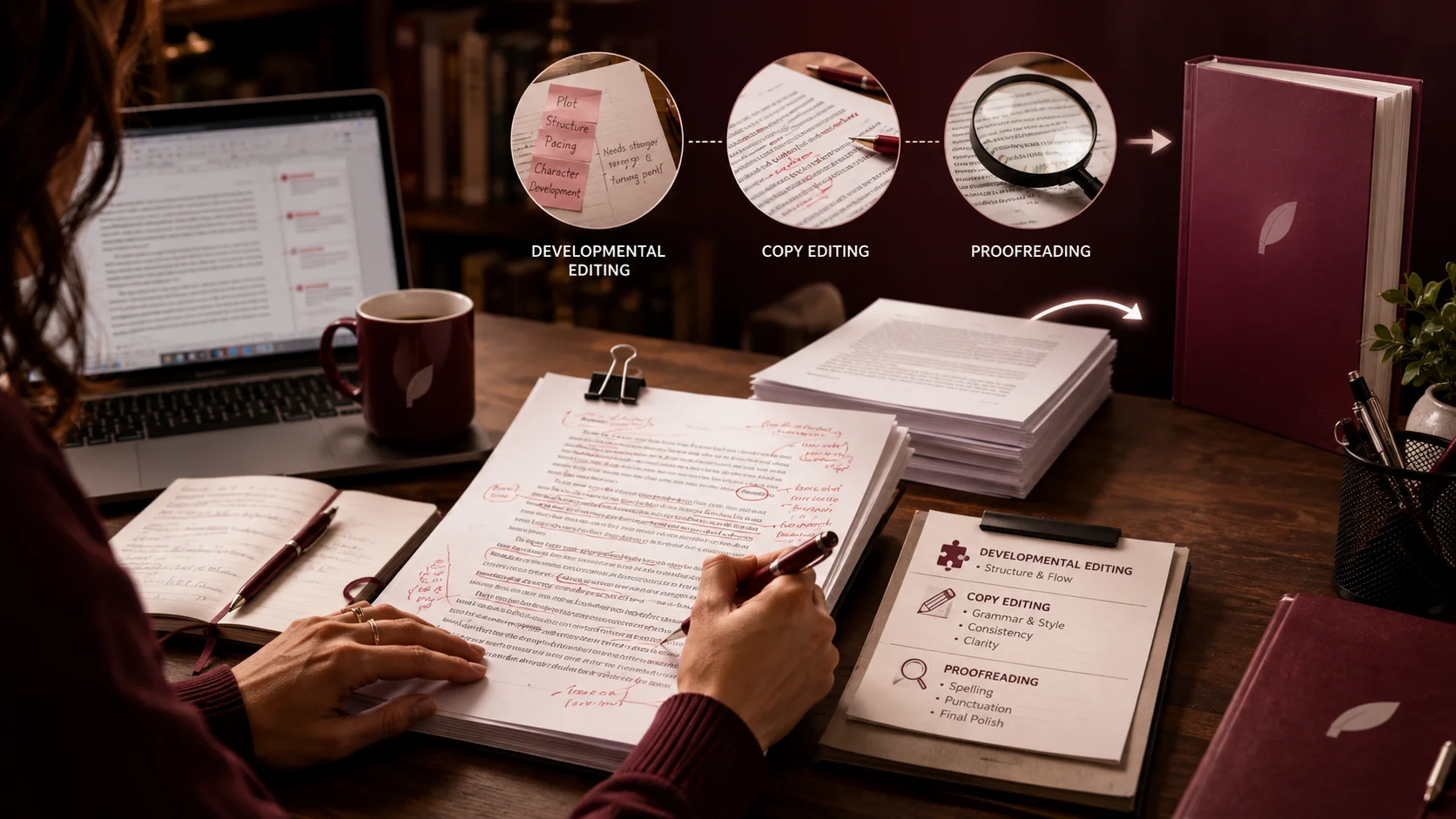
Editing is where good manuscripts become publishable books. Professional editing typically happens in three stages: developmental editing for structure and story, copy editing for clarity and consistency, and proofreading for the final error sweep. We explain each stage in detail in our guide on why professional book editing matters.
Readers in Australia and New Zealand expect local spelling conventions, so make sure your editor works in Australian or New Zealand English rather than US English. Our book editing service matches you with editors who understand the local market and keep your voice intact.
Never skip proofreading, even if your budget is tight. Online reviewers mention typos more than any other quality issue, and a single page of errors can undo months of writing work.
Step 3: Register Your ISBN and Meet Legal Requirements
An ISBN is the unique product number that retailers, libraries and distributors use to identify your book. Each format needs its own ISBN, so a paperback, hardcover and eBook edition of the same title use three different numbers.
In Australia, ISBNs are purchased from the official national ISBN agency. In New Zealand, the National Library of New Zealand issues ISBNs to local publishers and self publishing authors free of charge.
Both countries also have legal deposit rules. Australian publishers must deposit a copy of each published work with the National Library of Australia, and most states require a copy for the state library as well. New Zealand publishers deposit copies with the National Library of New Zealand. It is a simple administrative task, but it is a legal obligation, and it also preserves your book for future generations.
If that sounds like paperwork you would rather not manage, ISBN registration and copyright support are included in our publishing packages.
Step 4: Commission a Professional Cover Design
Readers absolutely judge books by their covers, especially online where your cover appears as a thumbnail beside dozens of competitors. A strong cover signals your genre instantly, looks clean at small sizes, and feels at home next to bestsellers in your category on Amazon Australia and Booktopia.
Study the top twenty books in your genre and note the patterns in typography, colour and imagery. Your cover should belong to that family while still standing out. A professional book cover designer will deliver the front cover for your eBook plus the full print wrap, including spine and back cover, sized precisely to your page count and trim size.
Step 5: Format the Interior for Print and eBook
Formatting, also called typesetting, turns your edited manuscript into the finished pages a reader holds. Print formatting sets your trim size, margins, fonts, chapter openers and front matter. eBook formatting produces a reflowable file that adapts to any screen size on Kindle, Apple Books and Kobo.
Poor formatting is easy to spot: cramped margins, inconsistent spacing, widowed lines and broken eBook layouts. Professional book formatting ensures your files pass the technical checks at Amazon KDP and IngramSpark the first time, which protects your launch schedule.
Step 6: Choose Your Publishing Path
Authors in Australia and New Zealand have three realistic routes to publication.
| Path | How It Works | Best For |
|---|---|---|
| Traditional publishing | You submit to publishers or agents. The publisher pays the costs and pays you royalties, usually after a long submission process. | Authors with time to query and a manuscript suited to large commercial lists |
| Pure self publishing | You manage every step yourself, hiring freelancers for editing, design and formatting, and uploading files to each platform. | Hands on authors who enjoy project management |
| Supported publishing | A professional team handles editing, design, ISBN, distribution and marketing for a fixed fee while you keep 100% of rights and royalties. | Authors who want professional quality without the workload |
There is no single right answer. The best path depends on your goals, your timeline and how much of the process you want to own. Whichever route you choose, you should always retain the rights to your work. That principle is non negotiable at ANZ Publishing House.
Step 7: Set Up Distribution
Distribution is what makes your book buyable. For most independent authors the core channels are Amazon KDP for the worldwide Kindle store and print on demand paperbacks, IngramSpark for bookshop and library distribution, and aggregators that reach Apple Books, Kobo and Google Play.
For Australian and New Zealand authors, local visibility matters too. Booktopia is one of the most trusted online bookstores in the region, and getting listed there puts your book in front of committed local readers. Print on demand means a copy is printed only when someone orders it, so you never need a garage full of stock, although a short offset print run still makes sense for launch events and direct sales.
Step 8: Price Your Book and Understand Royalties
Pricing is a balance between perceived value and competitiveness. Browse your category on Amazon Australia and note the typical range for books of your length and genre. eBooks priced between $4.99 and $9.99 generally earn the highest royalty rates on Amazon, while paperback pricing needs to cover the print cost with a sensible margin left over.
Remember that every platform takes its share. Run the numbers for each channel before you commit, and revisit pricing after launch if sales stall. Small adjustments can make a measurable difference.
Step 9: Plan Your Launch and Marketing
Marketing works best when it starts before publication day. Build a simple author platform early: an author website with an email signup, social profiles in your name, and advance copies in the hands of early readers who can review the book the week it goes live.
After launch, the work shifts to steady visibility: Amazon keyword and category optimisation, review generation, content and social media, and targeted advertising. We cover the full playbook in our guide to book marketing strategies for Australian and New Zealand authors, and our book marketing team can run it for you.
How Long Does the Whole Process Take?
With a professional team, most books move from finished manuscript to published title in 8 to 16 weeks. Editing is usually the longest stage, followed by design and formatting, then the technical setup of ISBNs, distribution and retail listings. Building in review time at each stage keeps the schedule realistic and protects quality.
Conclusion
Publishing a book in Australia is not a mystery. It is a sequence: polish the manuscript, edit professionally, register your ISBN and meet legal deposit requirements, design a genre true cover, format for print and digital, choose your path, set up distribution, price sensibly and market with intent. Authors who respect each step end up with books that stand proudly beside anything from the big publishing houses.
If you would like a partner for the journey, ANZ Publishing House guides authors across Australia and New Zealand through every stage, and you keep 100% of your rights and royalties. Tell us about your book and we will reply with a clear, no obligation quote within one business day.