
Editing is the invisible craft behind every book you have ever loved. Here is why it deserves a place in your publishing budget.
Ask any successful author what they would never cut from their publishing budget and the answer is almost always the same: editing. Readers may never see your editor's name, but they feel the editor's work on every page. Clean prose, steady pacing, consistent characters and error free pages are what keep a reader inside the story instead of stumbling out of it.
For independent authors in Australia and New Zealand, editing is also a commercial decision. Your book will sit beside traditionally published titles on Amazon Australia and Booktopia, and readers hold every book to the same standard. This article explains what professional editing actually involves, what each stage delivers, and how to work with an editor without losing your voice.
Key Takeaways
- Editing happens in three distinct stages, and each catches problems the others cannot
- Reviews mentioning typos and errors are among the most common reasons readers abandon independent books
- Australian and New Zealand readers notice US spelling, so localisation matters
- A good editor strengthens your voice instead of replacing it
- Self editing first makes professional editing faster and more affordable
What Professional Editing Actually Involves
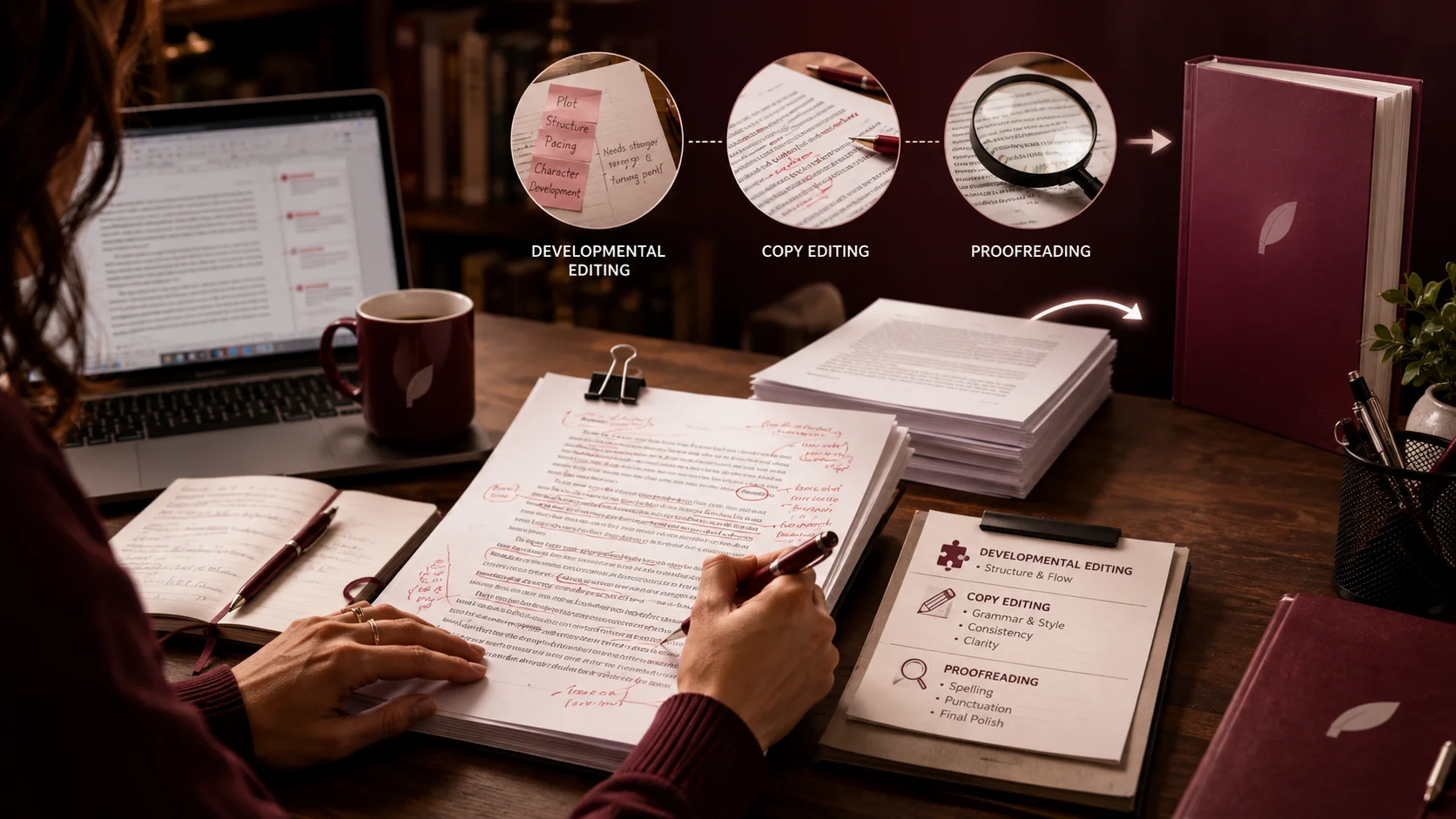
Many first time authors imagine editing as a single pass for typos. In practice, professional editing is a layered process that moves from the big picture down to the smallest detail. Each layer answers a different question. Does the story work? Does every sentence earn its place? Is every page technically clean?
Skipping a layer does not save money so much as move the cost. Structural problems that survive into a published book show up later as poor reviews, low completion rates and weak word of mouth, which are far more expensive to fix than a manuscript ever was.
The Three Stages of Editing Explained
| Stage | What It Fixes | When It Happens |
|---|---|---|
| Developmental editing | Structure, plot, pacing, character arcs, argument flow in non fiction, chapter order and missing scenes | First, on the full draft |
| Copy editing | Grammar, sentence rhythm, word choice, repetition, consistency of names, timelines and facts | Second, once the structure is settled |
| Proofreading | Typos, punctuation slips, spacing and layout errors on the final formatted pages | Last, after formatting and before printing |
Developmental Editing: The Story Level
A developmental editor reads your manuscript the way your toughest reader would. They identify where momentum stalls, where motivation is unclear, and where chapters need reordering, merging or cutting. The feedback usually arrives as a detailed editorial letter plus margin notes. It can be confronting to read, but it is the stage where books improve the most.
Copy Editing: The Sentence Level
Copy editing turns a structurally sound draft into clean, professional prose. Beyond grammar, a copy editor tracks consistency: a character whose eye colour changes between chapters, a timeline that quietly loses a week, or a product name spelled three ways. The editor also builds a style sheet recording every decision, which keeps your future books consistent too.
Proofreading: The Final Safety Net
Proofreading happens after formatting, on the pages exactly as readers will see them. The proofreader catches what every earlier pass missed, plus errors introduced during layout: a dropped line, a doubled word, a wrong running header. It is the cheapest stage of editing and the one with the most visible payoff.
Order matters. Proofreading before a copy edit wastes money, because the copy edit will rewrite sentences the proofreader already checked. Always finish the bigger work first.
Why Australian and New Zealand English Matters
Spelling and usage signal who a book was written for. Australian and New Zealand readers expect colour rather than color, realise rather than realize, and metric measurements in everyday description. A manuscript that mixes conventions reads as careless even when the story is strong.
Localisation also reaches beyond spelling into idiom, punctuation style and even how dialogue is punctuated. An editor based in the ANZ market applies these conventions automatically. It is one of the quiet advantages of working with a local team like ANZ Publishing House rather than an offshore service that defaults to US rules.
What Editing Costs, and What It Saves
Editing is typically priced per word, with deeper editing levels costing more than lighter ones. That makes the total a function of two things: how long your book is, and how much work it needs. A well self edited 70,000 word novel costs less to edit than a rough 120,000 word draft, which is the practical reason to polish before you submit.
Now weigh the cost against what editing prevents. Reader reviews that mention errors suppress sales permanently. Retailers can pull poorly produced books from sale. And a disappointed reader rarely buys the sequel. Editing is not an expense added to your book; it is insurance on every other dollar you spend publishing it.
A Self Editing Checklist Before You Hire Anyone
- Rest the manuscript for at least two weeks, then reread it in a different format, such as on paper or an e reader
- Read dialogue aloud and cut anything you stumble over
- Search for your personal crutch words and trim them
- Check chapter openings and endings, since these carry the most weight
- Run a spelling and grammar tool as a first sweep, not a final verdict
- Give the draft to two or three honest readers and look for patterns in their feedback
If you reach this point and the story itself still feels stuck, a ghostwriter or developmental editor can help you rebuild it before the sentence level work begins.
How to Choose the Right Editor
Look for three things. First, genre experience: an editor who mainly works on business books will serve your thriller poorly, and vice versa. Second, a sample edit: reputable editors and publishing teams will edit a few pages so you can see how they handle your voice. Third, a clear process: defined stages, tracked changes, a named editor and a schedule in writing.
Be cautious of anyone who promises a single cheap pass will make a manuscript publication ready, and equally cautious of vague quotes that cannot say what level of editing is included. A professional quote names the stages, the timeline and the price.
What Working With an Editor Looks Like
A typical engagement starts with a sample review of your manuscript and a quote. Once you approve, the editor works through the agreed stages, returning your manuscript with tracked changes and comments. You accept or decline each change, ask questions, and send it back for a final review. Nothing is forced on you. The result is a stronger book that is still unmistakably yours.
From there, the polished manuscript flows into cover design and formatting, and onward to publication. If you want to see how editing fits into the full journey, read our step by step guide to publishing a book in Australia.
Conclusion
Every book that feels effortless to read was edited, usually several times, by professionals who knew exactly what to look for. Editing protects your story, your reputation and your sales, and it is the clearest signal to readers that you take your work seriously.
ANZ Publishing House provides developmental editing, copy editing and proofreading by editors who work in Australian and New Zealand English and keep your voice intact. Send us your manuscript details and we will come back with a free sample assessment and a fixed quote within one business day.